
ZWD831 Single-Channel RF Remote Control Decoder IC
Single-channel wireless RF remote decoder IC in SOP8. Auto-detects 1527 and 2262 codes, learns up to 40 remotes, and offers momentary, toggle, interlock, batch and delay modes with a 2.0-5.5 V supply.
Request a quote for this model: info@zowinda.com
Technical specifications
| Package | SOP-8 |
|---|---|
| Supply voltage | 2.0 - 5.5 V (3.3 V / 5.0 V recommended) |
| Standby current | approx. 3 mA @ 5 V |
| Supported protocols | 1527 / 2262, automatic detection |
| Address space | 1527: 20-bit (~1.04M codes); 2262: 12-bit (~4096 codes) |
| Remote memory | up to 40 remotes, retained >10 years |
| Working modes | momentary / toggle / interlock / batch / delay |
| Output | 1 channel, drives a 5 V relay directly |
| Operating temperature | -40 to +85 °C (industrial) |
Protocols & interfaces
Overview
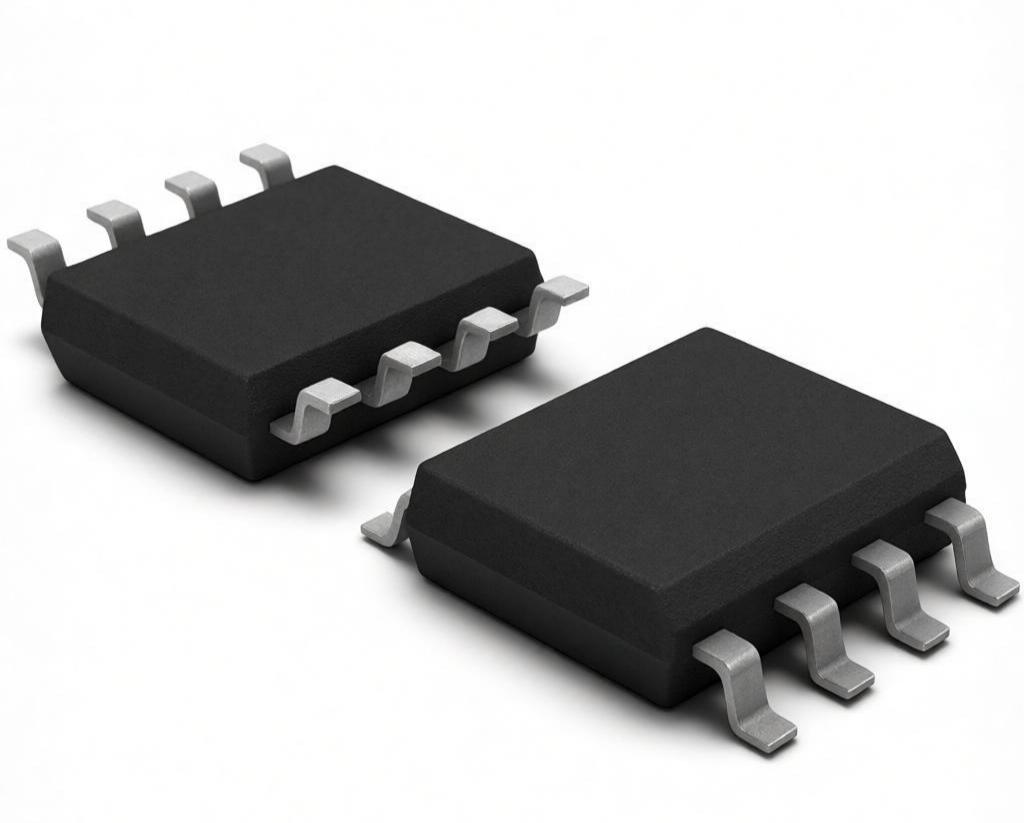
ZWD831 is a single-channel wireless RF remote control decoder IC developed by Zowinda. Housed in a compact SOP8 package, it works with a 315 / 433 MHz superheterodyne receiver module and a few external components to form a complete wireless remote receiver board — no microcontroller or firmware development required.
The IC automatically recognizes the two mainstream remote encoding protocols, 1527 and 2262, and supports five control modes: momentary, toggle, interlock, 1527 batch and delay. It can learn and store up to 40 remotes, with data retained after power-off. It suits end-product development for smart lighting, industrial remote control, access control, electric doors and windows, and automatic lighting.
Key features
- Easy to use — works with a superheterodyne receiver module to form a complete receiver board
- Wide module compatibility — supports 315 MHz / 433 MHz / 868 MHz superheterodyne modules
- Auto protocol detection — adapts to 1527 and 2262 codes automatically, no configuration
- Five working modes — momentary, toggle, interlock, batch and delay for a wide range of applications
- 40-remote capacity — internal memory, data retained for over 10 years
- Compact SOP8 package — few external parts, ideal for miniature product designs
- Wide voltage range — 2.0 V to 5.5 V, supports battery or mains power
- Industrial temperature range — -40 °C to +85 °C for demanding environments
Electrical characteristics
| Parameter | Specification |
|---|---|
| Operating voltage | 2.0 V ~ 5.5 V (3.3 V / 5.0 V recommended) |
| Standby current | approx. 3 mA @ 5 V |
| Memory capacity | internal memory for 40 remotes |
| Memory endurance | 100,000 write/erase cycles, data retained over 10 years |
| Compatible frequencies | 315 / 433.92 / 868 MHz (depends on the module) |
| Sensitivity | down to -110 dBm (depends on module quality) |
| Decoding reliability | triple check: single-frame, frame consistency and address matching |
Pin configuration
| Pin | Name | Function |
|---|---|---|
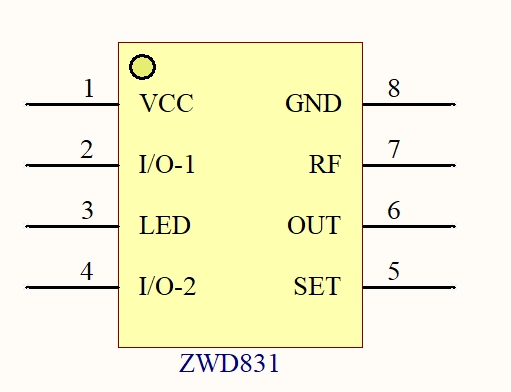
| 1 | VCC | Positive supply input (2.0 V ~ 5.5 V) |
| 2 | I/O-1 | Reserved I/O pin (customizable function) |
| 3 | LED | Learning indicator drive (active high) |
| 4 | I/O-2 | Reserved I/O pin (customizable function) |
| 5 | SET | Pairing key (active low; hold 4 s to learn, 10 s to clear) |
| 6 | OUT | Relay control output (high = energized) |
| 7 | RF | Receiver module data input (connect to module DATA) |
| 8 | GND | Ground |
Reference circuit
The English schematic below shows the complete reference circuit for the ZWD831. It includes the SOP8 decoder IC with its VCC decoupling capacitor C1 (104), a 315/433 MHz RF receiver module M1 with an external antenna, the SET pairing key S1, and a status LED indicator D1. The output drive stage consists of a transistor Q1 (S8050) driving a 5 V relay J1 (RD-105DM) protected by a 4148 flyback diode. This minimal configuration allows for immediate implementation of wireless remote switching functions.
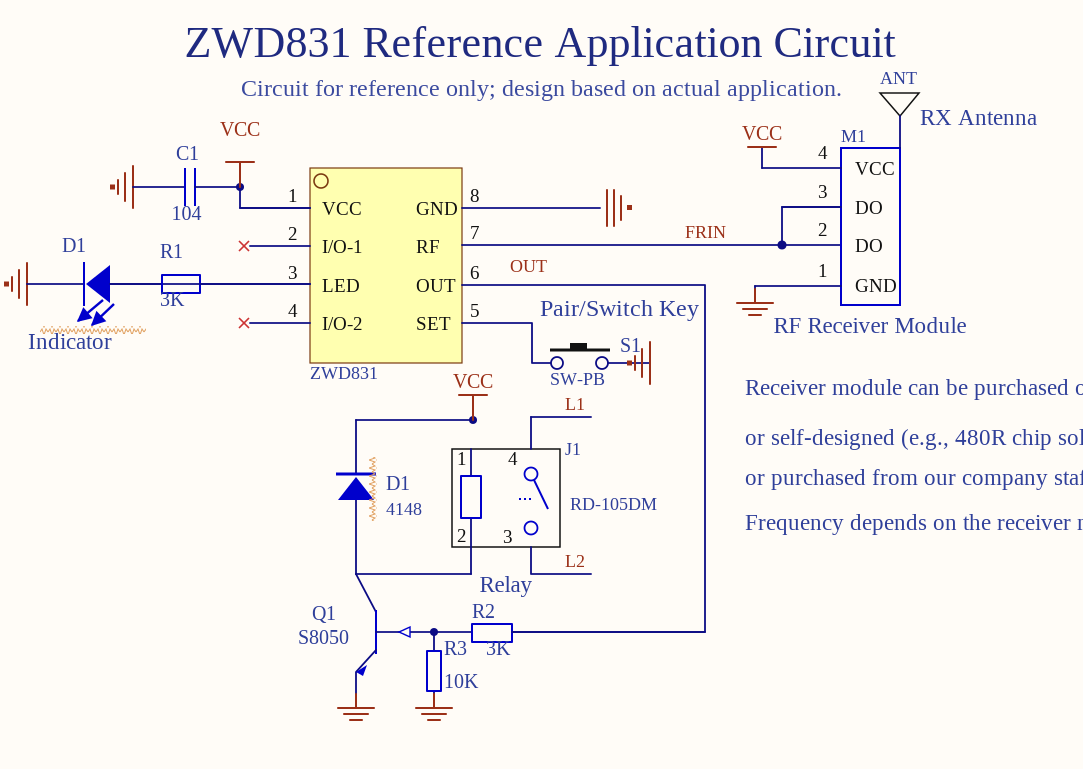
ZWD831 needs minimal external circuitry. A 315 / 433 MHz superheterodyne receiver module, a pairing key, an LED with a current-limiting resistor, a 5 V relay with a flyback diode, and power decoupling capacitors are sufficient to build a complete remote receiver.
Design notes: place a 10 kΩ resistor in series between the RF input and the module DATA pin with a 100 nF capacitor to ground; connect a flyback diode (1N4148 or 1N4007) in reverse across the relay coil; and keep the RF module away from high-frequency switching parts such as relays and DC-DC converters in the PCB layout.
Working modes
Select a mode by holding SET for 4 seconds to enter learning mode, then short-pressing SET 1 to 9 times.
| Mode | Short-presses | Typical use |
|---|---|---|
| Momentary | 1 | Output on while the key is held — shutter up/down, doorbell |
| Toggle | 2 | Each press flips the output — light switch, power socket |
| Interlock | 3 | Two keys for ON and OFF — curtain, door lock |
| 1527 batch | 4 | One remote stores four keys with four delays |
| Delay | 5 to 9 | Output on, auto-off after 10 / 30 / 60 / 180 / 600 s |
In 1527 batch mode, one learning process stores all four key codes of a remote and assigns fixed delays: 0x08 = 30 s, 0x04 = 60 s, 0x02 = 180 s, 0x01 = 600 s. In delay mode, pressing any delay key during the countdown restarts the timer from the last press.
Learning and pairing
Hold SET for about 4 seconds — the LED blinks 3 times then stays on, indicating learning mode. Short-press SET 1 to 9 times to select the mode, then press a remote key once; the LED blinks 3 times to confirm a successful learn. The IC exits learning mode automatically after a successful learn or 20 seconds of inactivity.
To clear all remotes, hold SET for about 10 seconds while in learning mode; the LED blinks 4 times and the memory is erased. The same mode can learn up to 40 different remotes, each occupying one slot; once full, a newly learned remote overwrites the earliest one.
Typical applications
- Smart lighting — remote lights, delay lights, corridor lights
- Electric doors and windows — rolling shutters, garage doors, telescopic gates
- Smart curtains — open / close curtains and blinds
- Security and alarm — IR sensors, door magnets, smoke detector interlocks
- Home appliance control — fans, exhaust fans, air-conditioner sockets
- Hotel rooms — single-channel, multi-level delay lighting
- Industrial control — remote switches, pump and valve control
- Smart agriculture — irrigation systems, shutter control
Customisation and support
Function mix, firmware behaviour and packaging can be adjusted to the project. We confirm requirements first, build a sample for validation, and schedule production after approval. Contact our team for the latest datasheet, sample availability and volume pricing.