
ZWD-RELAY Dual-Band Transparent RF Repeater — 315/433 MHz Cross-Band Signal Extender
Compact SOP8 dual-band RF repeater that transparently forwards 315 MHz and 433 MHz remote signals with the address and key code unchanged. Selectable same-frequency or cross-band forwarding, 0.3 s anti-collision delay and 8× frame repeat.
Request a quote for this model: info@zowinda.com
Technical specifications
| Package | SOP-8 |
|---|---|
| RF inputs | 315 MHz (pin 7), 433 MHz (pin 6) |
| RF outputs | 315 MHz (pin 2), 433 MHz (pin 3) |
| Mode select | Pin 5 — floating / HIGH = same-frequency; LOW to GND = cross-frequency |
| Status LED | Pin 4 — power-on self-test and transmit indication |
| Forwarding method | Transparent signal forwarding |
| Compatible codes | EV1527, PT2262 and compatible address + key code formats |
| Frame repeat | 8 repetitions per captured frame |
| Forward delay | 0.3 s |
| Code integrity | Address code and key code identical to the original signal |
Protocols & interfaces
Product overview
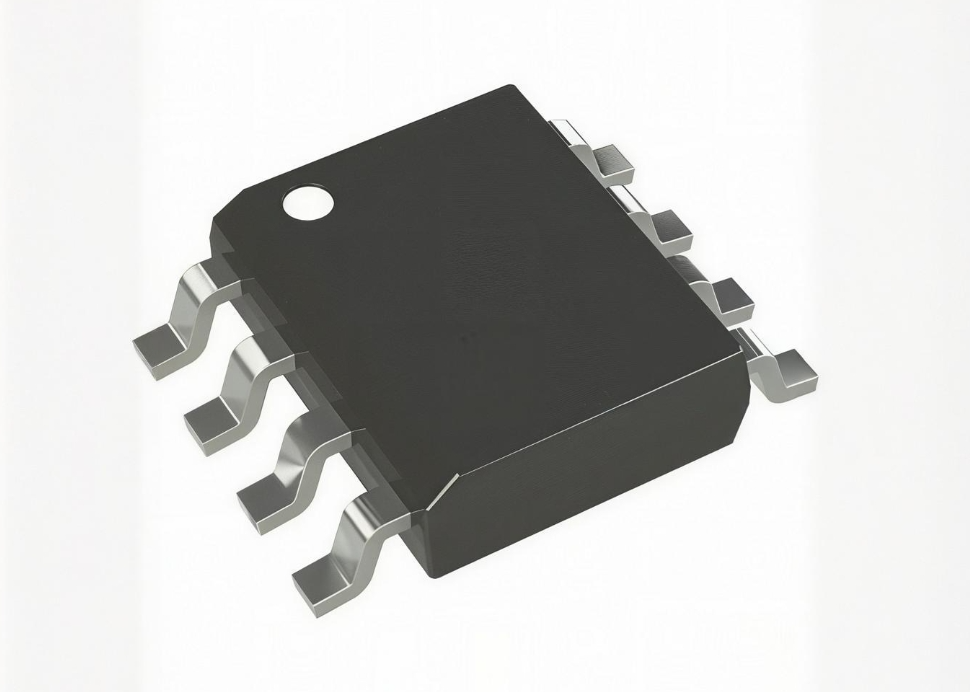
The ZWD-RELAY is a compact 8-pin SOP8 dual-band RF repeater for 315 MHz and 433 MHz remote controls. It faithfully reproduces the incoming RF signal, preserving the original address code and key code exactly — it works with EV1527, PT2262 and compatible remotes without any pairing or configuration. What you send is what gets repeated.
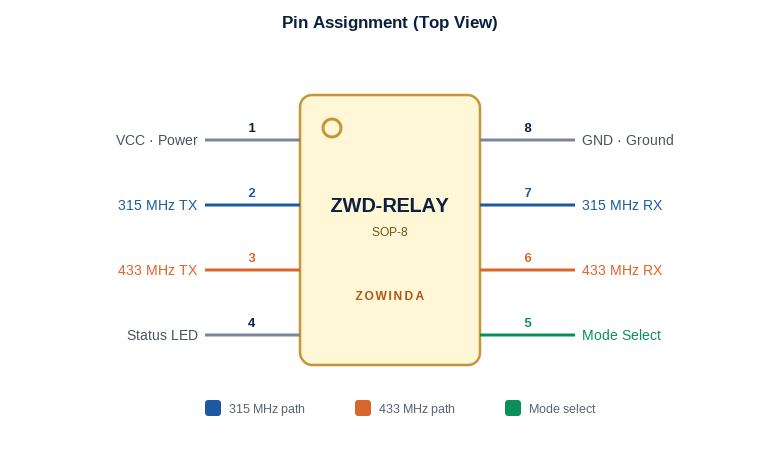
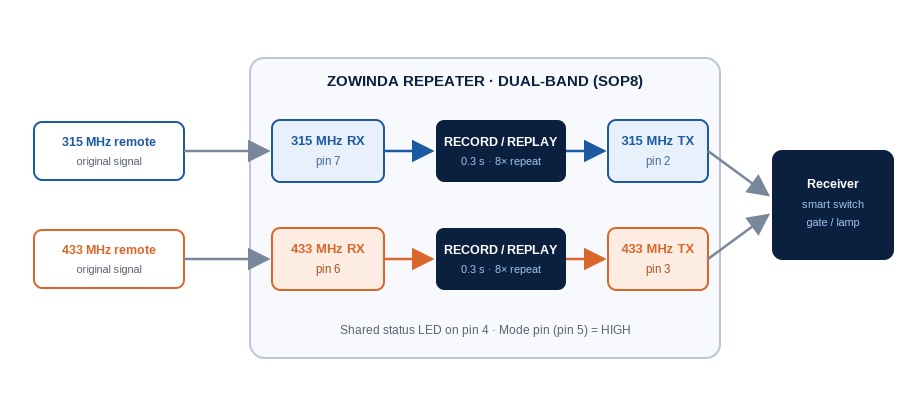
Two RF bands are handled at the same time. The 315 MHz and 433 MHz receivers each listen independently; whichever receives a valid signal first handles the forwarding, and the other channel stands by. A single mode pin selects whether the frame is sent back on the same band or handed over to the opposite band — a simple, wire-selectable way to remove same-frequency interference.
Key features
- True transparent forwarding — reproduces the original signal exactly; no learning or reconfiguration, any compatible remote works out of the box.
- Dual independent paths — 315 MHz and 433 MHz each have their own receiver and transmitter; first valid signal wins.
- Cross-band selectable — one pin switches same-frequency or cross-frequency forwarding (315→433 / 433→315) with a single wire to ground.
- 0.3 s anti-collision delay — offsets the repeated signal from the original so the receiver never sees two overlapping waveforms.
- 8× frame repeat — each signal is repeated eight times for more reliable detection at the receiver.
- Code-preserving — address code and key code are identical to the source remote.
- Tiny SOP-8 — a complete dual-band repeater in an 8-pin footprint with very few external parts.
- Status LED — power-on self-test (about 0.5 s) and fast-blink transmit indication on a shared LED pin.
Pin configuration
The eight-pin mapping keeps both receive paths and both transmit paths on dedicated pins, with one shared status LED and one mode-select input. Unused receiver inputs are held high by internal weak pull-ups so a floating input cannot trigger false frames.
| Pin | Name | Description |
|---|---|---|
| 1 | VCC | Power supply |
| 2 | 315 MHz TX | 315 MHz transmitter output |
| 3 | 433 MHz TX | 433 MHz transmitter output |
| 4 | Status LED | Power-on self-test and transmit indication |
| 5 | Mode Select | Floating / HIGH = same-frequency; GND = cross-frequency |
| 6 | 433 MHz RX | 433 MHz receiver input |
| 7 | 315 MHz RX | 315 MHz receiver input |
| 8 | GND | Ground |
Design tip: the mode pin (pin 5) is internally pulled high. Tie it to GND to enable cross-band mode. Both receiver inputs use internal weak pull-ups, so a floating input reads a steady HIGH and cannot create false frame triggers.
Operating modes
One firmware, two forwarding behaviours. The mode is read immediately before each transmission, so changing the wire takes effect on the very next key press — no re-flashing required. The receive, record, verification and replay logic is identical in both modes; only the output pin is swapped.
Same-frequency mode — mode pin floating / HIGH (default)
With the mode pin left unconnected, the internal weak pull-up reads a logic high. Each band is repeated back onto its own transmitter: 315 MHz in → 315 MHz out, 433 MHz in → 433 MHz out. This is the plug-and-play behaviour.
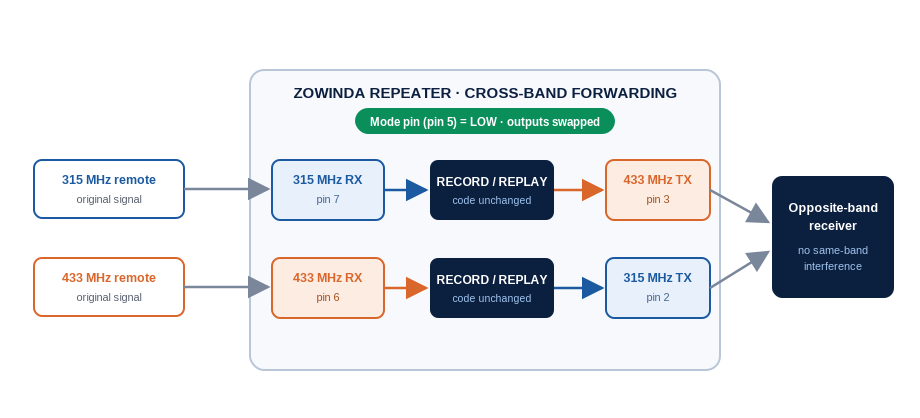
Cross-frequency mode — mode pin tied to GND
Pulling the mode pin low swaps the two transmit outputs: a 315 MHz frame is sent out through the 433 MHz transmitter, and a 433 MHz frame through the 315 MHz transmitter. The captured waveform — and therefore the address and key code — is unchanged. Pair this with a receiver module on the opposite band and the direct remote signal and the repeated signal never share a frequency, eliminating same-band self-interference entirely.
Anti-interference timing
In same-frequency operation a receiver can hear both the original remote and the repeater at once. If the two waveforms overlap out of phase, edges cancel or spurious pulses appear and decoding becomes unreliable. The repeater therefore waits 0.3 seconds after the last received edge before transmitting. The remote finishes its short burst first; the repeated frame follows later, so the receiver decodes them one after the other.
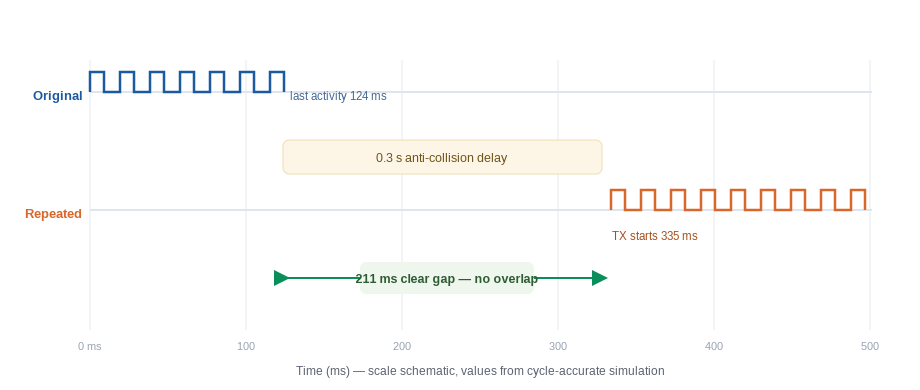
Why not transmit instantly? With zero delay the receiver hears the direct and repeated signals at the same time. Their relative phase drifts, so sometimes the edges align (decodes fine) and sometimes they cancel (fails). The 0.3 s offset removes this collision for short-press and latching remotes. For continuous-hold (momentary) remotes, either keep the repeater antenna close to the receiver and the remote further away, or use cross-band mode.
Applications
The repeater sits transparently between an existing remote and its receiver. No coding changes, no re-learning, no new remote — it simply extends or converts the RF link.
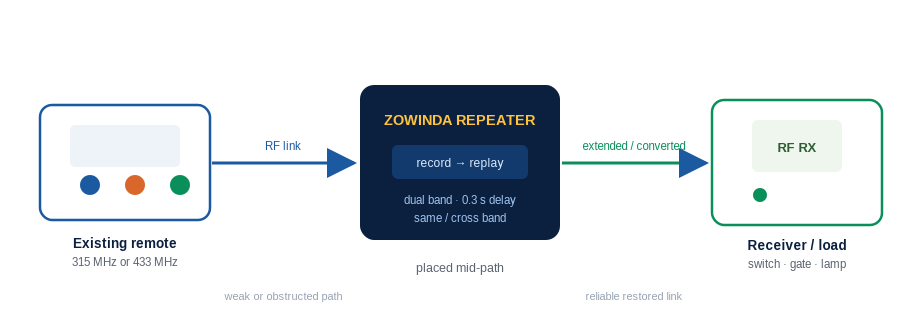
- Whole-house coverage — extend a remote through walls and across multiple floors without replacing the original transmitter.
- Gate and garage access — reach a distant gate or garage door from inside the building with the existing remote.
- Cross-band conversion — bridge a 315 MHz remote to a 433 MHz receiver, or the reverse, with one wire on the mode pin.
- Interference mitigation — cross-band mode removes same-frequency self-interference at the receiver completely.
- LED and switch retrofit — add reliable remote reach to smart switches and lighting without touching existing remotes.
- Industrial and warehouse — maintain robust RF control across large, metal-rich spaces and long cable runs.
Technical specifications
| Item | Specification |
|---|---|
| Package | SOP-8 |
| RF inputs | 315 MHz (pin 7), 433 MHz (pin 6) |
| RF outputs | 315 MHz (pin 2), 433 MHz (pin 3) |
| Mode select | Pin 5 — floating / HIGH = same-frequency; LOW to GND = cross-frequency |
| Status LED | Pin 4 — power-on self-test and transmit indication |
| Forwarding method | Transparent signal forwarding |
| Compatible codes | EV1527, PT2262 and compatible address + key code formats |
| Frame repeat | 8 repetitions per captured frame |
| Forward delay | 0.3 s |
| Code integrity | Address code and key code identical to the original signal |
Channel behaviour: the two bands are fully independent. If both are pressed at almost the same instant, the first valid frame takes priority; separate them by roughly 0.6 s and both are repeated. The product is supplied as a programmable IC; RF modules and antennas are selected to suit the target frequency band.